
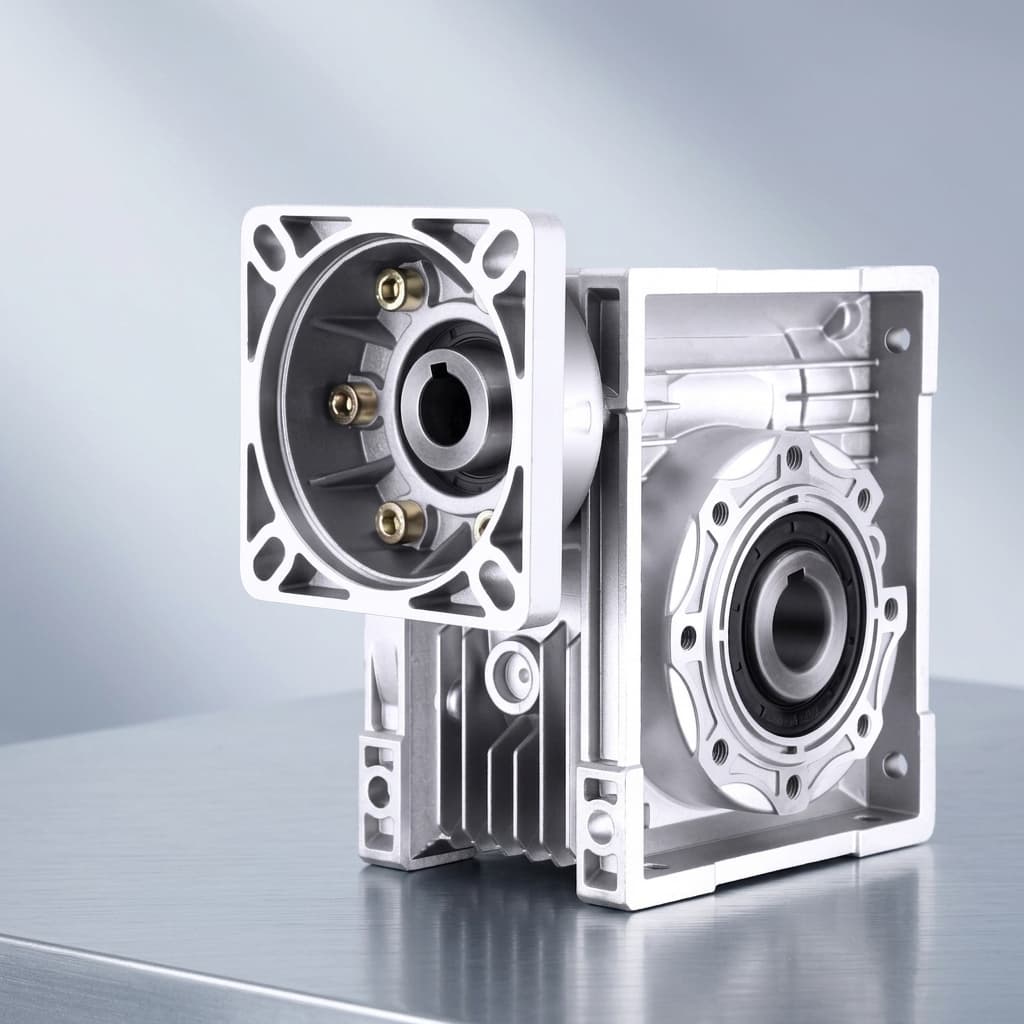
Cycloidal Gearbox vs Harmonic Drive: Engineering Tradeoffs for Robot Joints
A detailed engineering comparison of cycloidal gearboxes and harmonic drives. Learn how to choose the right reducer for payload, backlash, and shock resistance.
When designing a robotic joint, automation engineers face a critical decision: should they use a cycloidal gearbox (like an RV reducer) or a harmonic drive (strain wave gear)? Both can support low-backlash precision, but they operate on entirely different mechanical principles and excel in different applications.
[!TIP] Key Takeaways
- Cycloidal Gearboxes (RV) are often selected for heavy payloads because they can provide higher shock-load margin and strong torsional rigidity when sized correctly.
- Harmonic Drives are ideal for ultra-compact, lightweight joints where payload is low and space is at a premium.
- Lifetime: RV reducers often hold their lost-motion target longer because they rely on rolling contact rather than flexspline deformation.
Here is an engineering comparison to help narrow the right reducer path for your robot.
1. Operating Principle
Harmonic Drives rely on the elastic deformation of a thin-walled steel cup (the flexspline). An elliptical wave generator rotates inside the flexspline, forcing its teeth into engagement with a rigid circular spline. Because the flexspline has two fewer teeth than the circular spline, one full rotation of the wave generator advances the flexspline by two teeth, creating a high reduction ratio.
Cycloidal Gearboxes (RV Reducers) utilize a two-stage reduction. The first stage uses spur gears to reduce speed and distribute torque to multiple crankshafts. The second stage uses these crankshafts to drive cycloidal discs with epitrochoidal teeth in an eccentric motion against stationary outer pins.
Cycloidal Gearbox
Harmonic Drive
2. Load Capacity and Torsional Rigidity
This is where the two technologies diverge most sharply.
- Harmonic Drives: The torque is transmitted through a flexible, thin-walled steel cup. While highly precise, the flexspline fundamentally limits the maximum torque and torsional rigidity. Under heavy loads, the joint may exhibit "wind-up" or deflection.
- Cycloidal Gearboxes: Torque is transmitted through multiple cycloidal discs and pins. Because load is shared across many teeth simultaneously without relying on flexspline deformation, cycloidal gearboxes can provide high torsional rigidity.
Engineering direction: For payloads under 10 kg (e.g., collaborative robots, humanoid arms, small SCARAs), strain-wave gearing is often evaluated first for packaging. For payloads from 20 kg up to heavy industrial classes, cycloidal gearboxes are often the stronger candidate because torque, stiffness, bearing support, and shock load dominate.
3. Shock Load Resistance
In industrial environments, robots frequently experience emergency stops or accidental collisions.
A harmonic drive's flexspline can be susceptible to ratcheting, fatigue, or fracture if subjected to a severe torque spike. In contrast, many RV reducer catalogs specify a short-duration peak torque margin above rated torque. The exact shock-load limit must be checked by model, load case, and duty cycle.
4. Size, Weight, and Ratio
Strain-wave reducers usually have the advantage on compactness and weight. A harmonic drive can deliver high reduction ratios in a compact package, which is why it remains common in small joints.
Cycloidal gearboxes are usually heavier and need more envelope because of their load-sharing discs, pins, bearings, and housing. Micro-cycloidal gearboxes reduce that gap for humanoid knees, hips, shoulders, and other compact axes where stiffness and impact margin matter.
5. Wear and Lifetime (Backlash Degradation)
Over tens of thousands of hours of continuous operation:
- Harmonic Drives: The continuous flexing of the flexspline eventually causes metal fatigue. Additionally, as the teeth wear, lost motion can begin to increase.
- Cycloidal Gearboxes: Because the internal components use rolling contact rather than sliding contact, wear is minimized. High-quality RV reducers are designed to hold low-backlash performance across the rated life when correctly sized and lubricated.
Quick Comparison Summary
| Feature | Cycloidal Gearbox (RV) | Harmonic Drive (Strain Wave) |
|---|---|---|
| Primary Advantage | Torsional Rigidity, Shock Resistance | Extreme Compactness, Low Weight |
| Typical Backlash | < 1 arc-min options | Near-zero lost motion options |
| Shock Load Capacity | Model-specific peak torque margin | Lower shock margin; ratcheting risk must be reviewed |
| Wear Mechanism | Rolling Contact (Low wear) | Flexing/Sliding (Fatigue over time) |
| Typical Fit | Heavy industrial robots, AGVs | Cobots, humanoid arms, compact service robots |
Conclusion
If your application demands extreme compactness and light weight for a low-payload application (like small cobot wrists or compact service robot joints), choose a Harmonic Drive.
If your application requires high torsional rigidity, heavy payload capacity, and strong shock-load margin (like 6-axis industrial robots, heavy positioners, or AGV drive wheels), evaluate a Cycloidal Gearbox.
Need help sizing a cycloidal gearbox for your next heavy-duty project? Reach out to our engineering team for a detailed torque and duty-cycle review.
Author

Categories
More Posts
Predictive Maintenance for RV Reducers: A Buyer's and Engineer's Guide to Condition Monitoring
Discover how vibration analysis and thermal imaging can detect RV reducer degradation hours before failure, reducing TCO and unplanned downtime.
Hollow Shaft RV Reducers: Engineering and Sourcing Guide for Internal Cable Routing
Discover how hollow shaft RV reducers solve high-density wiring challenges in modern robotics. A complete guide on torque ratings, bore sizing, and procurement.
RV Reducer Selection for Heavy-Payload Collaborative Robots (20kg+)
Use this guide to select RV reducers for 20kg+ cobots: compare harmonic drives, torque, stiffness, friction, hollow shafts, and sourcing risks.